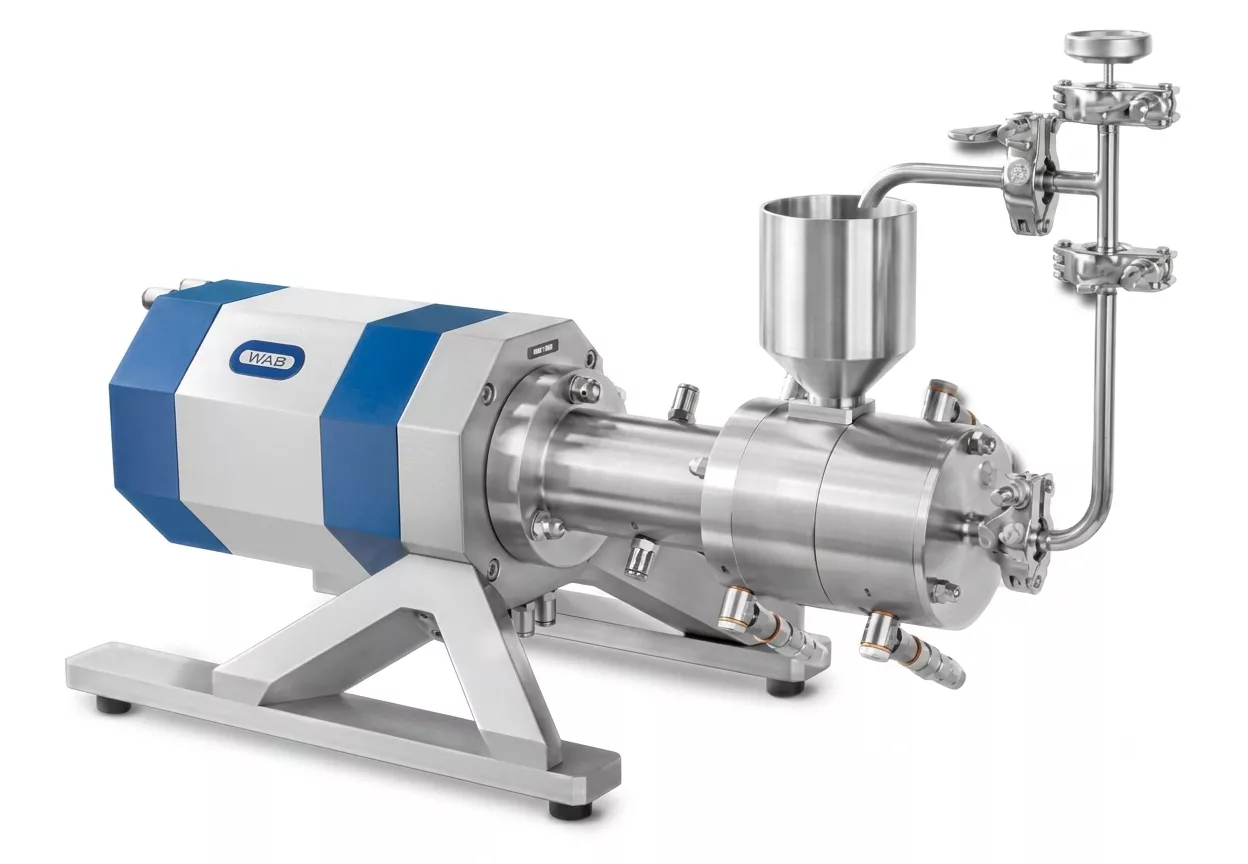
Continuous-flow mechanochemical reactor
As part of strengthening its platform dedicated to mechanochemistry and sustainable materials transformation, Materia Nova has acquired a continuous mechanochemistry reactor, the DYNO®-MILL RESEARCH LAB. This equipment represents a key technological asset for the development of continuous mechanochemical processes, enabling the use of mechanical energy as a driver for material modification, activation, and structuring.
The principle is based on the controlled transfer of high mechanical energy density through grinding beads set in high-speed motion within a liquid or viscous medium. This intense mechanical action promotes not only the deagglomeration and homogeneous dispersion of particles but also enhances their surface reactivity and activates physicochemical phenomena, paving the way for new functionalization strategies. The process makes it possible to act on materials at various scales, from particle size reduction down to the nanometric range (<100 nm) to the development of complex suspensions with controlled properties.
This equipment fully integrates with Materia Nova’s approach to the development of innovative and circular materials, complementing our expertise in reactive extrusion. Upstream of melt-processing operations, the DYNO®-MILL enables the exploration of new material preparation pathways through innovative synthesis and modification routes with reduced environmental impact.
Designed for research and development needs, the DYNO®-MILL RESEARCH LAB offers high operational flexibility. It allows the processing of small volumes, from approximately 100 mL up to a few liters, making it particularly suitable for feasibility studies, formulation screening, and rapid process optimization. The use of very small beads (0.05–1 mm), as well as ceramic configurations, enables high levels of fineness while limiting the risk of metallic contamination.
Operation in liquid or viscous media, combined with an efficient cooling system, allows the processing of thermosensitive compounds and reactive systems under controlled conditions. The equipment can be operated in continuous or recirculation mode and offers high versatility regarding the nature of the media: aqueous or organic suspensions, viscous or heterogeneous systems, and formulations containing solvents or functional additives.
Application fields
- mechanochemical activation and functionalization of particles and (bio)polymers;
- development of functional additives, particularly for flame retardancy;
- synthesis of new molecules for pharmaceutical, medical, food, coatings and other applications;
- development of alternative synthesis routes with lower environmental impact;
- formulation of technical suspensions and complex systems;
- development of functional additives, particularly for flame retardancy;
- ...
Through this infrastructure, Materia Nova strengthens its positioning in the development of innovative processes combining mechanochemistry, process intensification, and more sustainable chemistry, serving the design of high-performance and circular materials.
Our strengths
- Materia Nova helps manufacturers make their chemical processes and materials more innovative and sustainable through scalable mechanochemistry. Materia Nova's Mechanochemistry platform combines two complementary mechanical activation pathways — continuous wet-phase ball milling (DYNO®-MILL) and solid/melt-phase reactive extrusion. This dual capability allows each project to be directed toward the tool best suited to the system's physical state and the target chemistry.