Gas Permeability Measurement (H₂, O₂, N₂, He and CO₂)
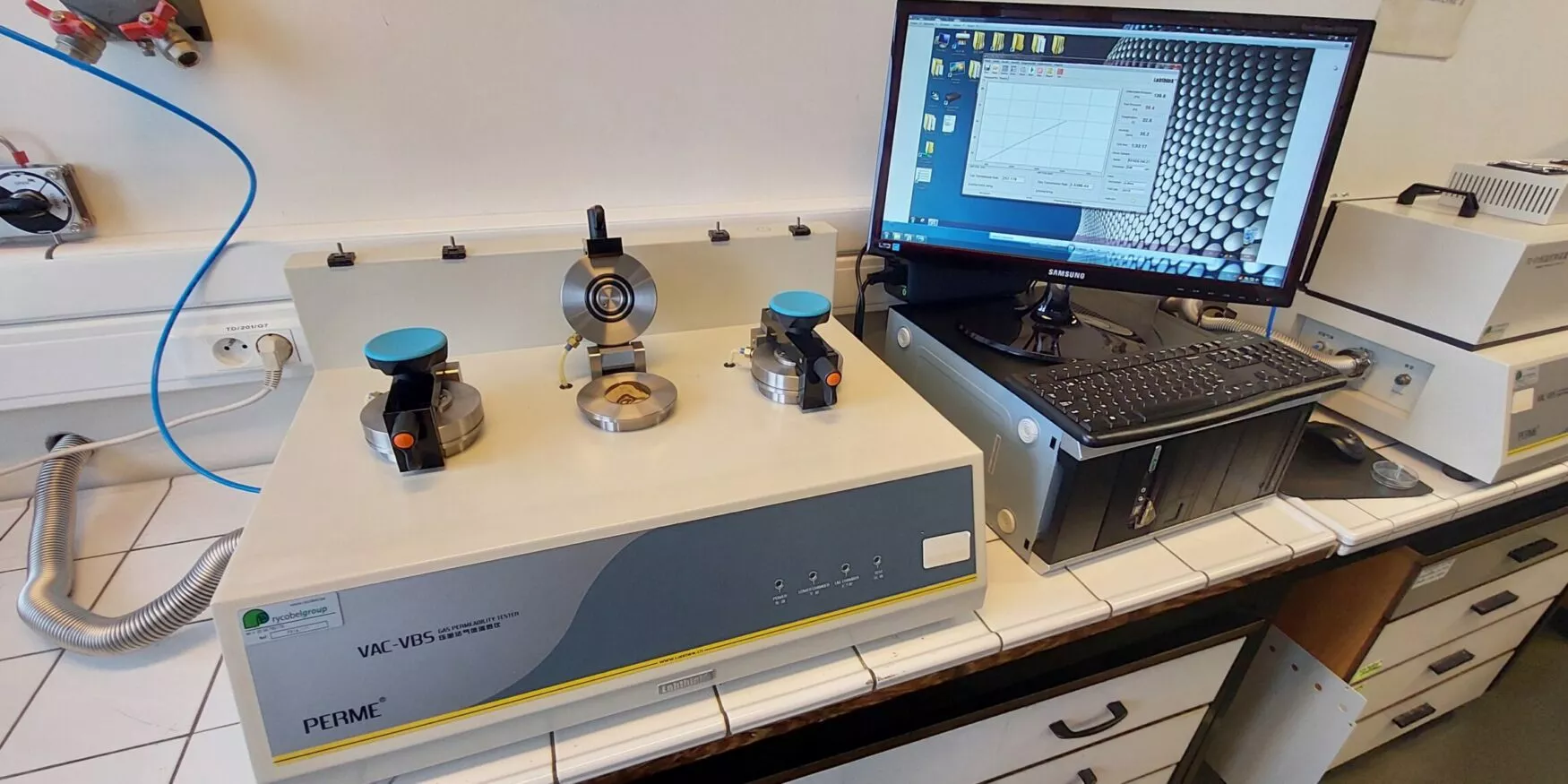
Our laboratory has two PERME VAC-VBS permeameters, based on the differential pressure method, allowing precise measurement of the gas transmission rate through films, sheets or barrier materials (plastics, composites, aluminium, etc.). The instrument can test several samples simultaneously, with a wide measurement range, and determines in particular the permeability to O₂, N₂, He and CO₂, according to international standards (such as ISO 15105-1, ASTM D1434, ISO 2556, GB/T 1038-2000, JIS K7126-1 and YBB 00082003). Thanks to this system, we carry out permeability measurements for packaging, technical materials and other industrial applications.
The principle is based on bringing a material sample into contact with the pressurized gas on one side, while the other side is kept under controlled conditions. The gas gradually diffuses through the material under the pressure gradient, and the flow is detected by an ultrasensitive sensor that directly detects the gas flux — unlike conventional pressure-variation methods — allowing quantities in the ppm range to be measured. The instrument can, however, also operate in pressure mode if required, and enables measurements across different pressure ranges (0–100 bar) and temperatures (-40 to 120 °C).
Hydrogen Permeability - H₂ Permeation & Barrier Testing
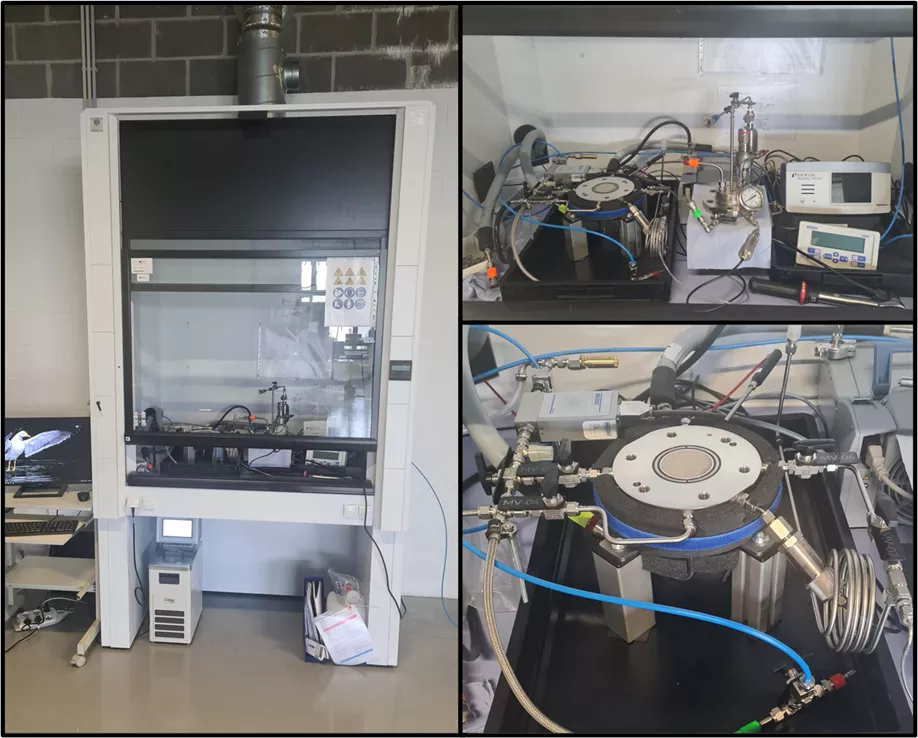
As part of the StorHyWall project, dedicated to the development of multi-material solutions for hydrogen transport and storage, Materia Nova has strengthened its characterization capabilities with a dedicated hydrogen permeameter. This equipment quickly measures hydrogen permeation through polymers, elastomers and composites using an ultrasensitive sensor that directly detects the hydrogen flux, unlike conventional pressure-variation methods. The instrument can also operate in pressure mode if required.
H₂ Permeation & Barrier Testing: answering a single question:"Does my material provide a sufficient barrier to hydrogen under my operating conditions?" The Materia Nova service answers this with a test report giving the steady-state H₂ flux, the permeance, the permeability (for homogeneous materials), the influence of temperature and pressure, and, for coated samples, the Barrier Improvement Factor.

Target markets: Hydrogen tanks (type IV) and polymer liners, seals and sealing materials, pipes and hoses, barrier coatings, materials for electrolysers and fuel cells.
Our differentiation: Few players combine H₂ permeation measurement with the ability to deposit the barrier coating itself (PVD/PECVD/ion implantation). This allows Materia Nova to provide not just a simple coefficient, but a result that is directly usable by the manufacturer — for example: "this coating reduces H₂ permeation by a factor of X at 40 °C and 3 bar."
Beyond characterization, Materia Nova supports the development and optimization of barrier materials for hydrogen storage, whether for tanks, pipelines or polymer components. More broadly, our expertise in barrier (waterproof or permeability) solutions enables us to design films and coatings offering controlled permeability properties, tailored to each application.