
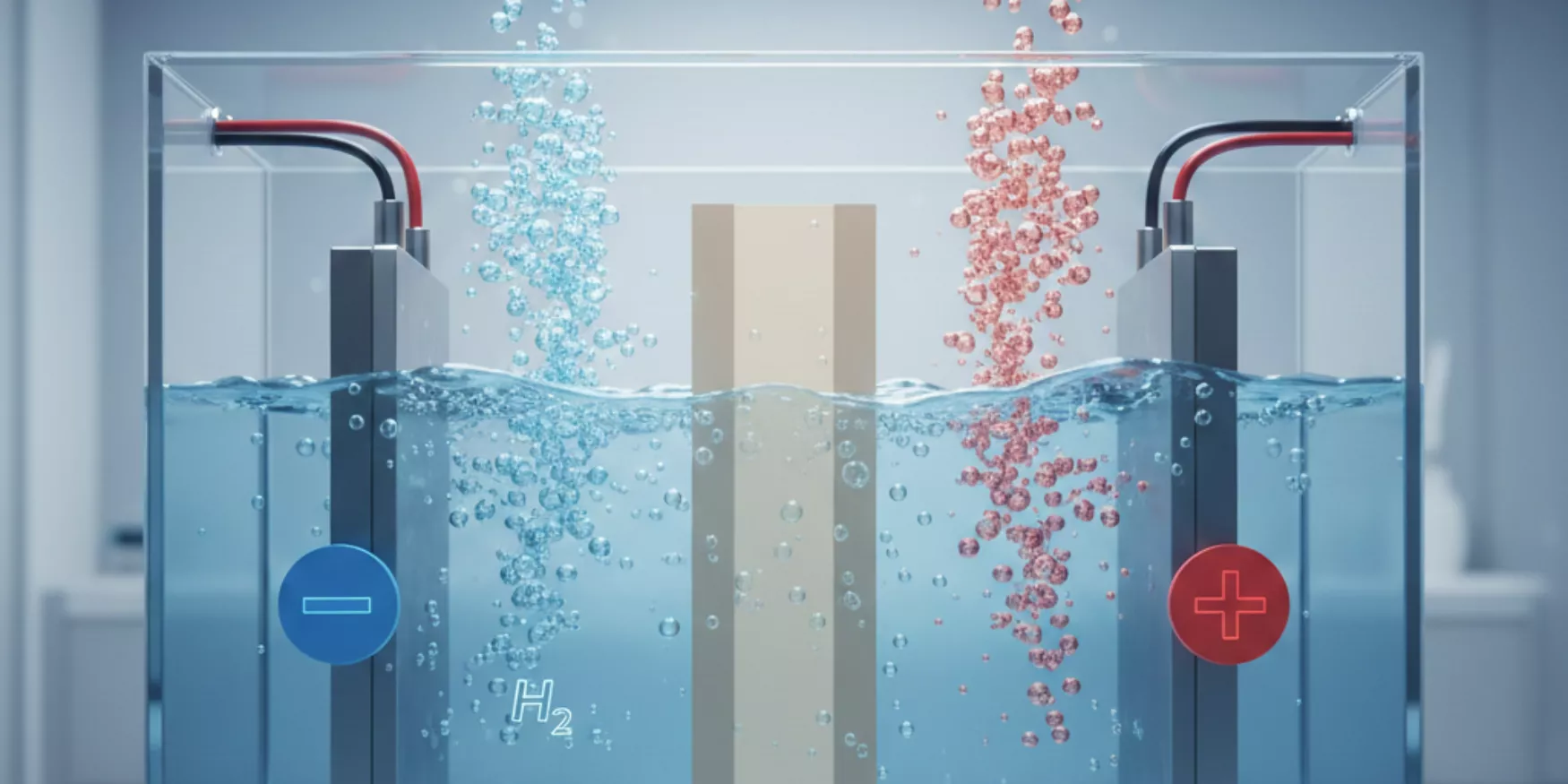
Alkaline Water Electrolysis
Alkaline water electrolysis is one of the most mature routes for producing decarbonised hydrogen from renewable electricity. It works by splitting water into hydrogen (at the cathode) and oxygen (at the anode) within a concentrated alkaline electrolyte (typically a potassium hydroxide solution, KOH), using metallic electrodes (nickel in particular, in the form of grids or foams).
This technology, proven at industrial scale, still faces several challenges in supporting large-scale coupling with intermittent renewable energy sources (solar, wind): material durability in concentrated alkaline media, management of frequent start/stop cycles, and system safety.
Managing gas crossover during stand-by phases
One of the major challenges of alkaline electrolysis coupled with intermittent energy sources is managing gas crossover (H₂/O₂ mixing) during stand-by phases, when the power supply is interrupted or fluctuating. Materia Nova is developing expertise in selective passivation coatings, deposited on metallic grid electrodes, designed to locally block the electrochemical reaction at a targeted area of the electrode, without compromising the conductivity or overall gas permeability of the system.
This approach draws on our proven deposition technologies (sol-gel, spray pyrolysis, sputtering, PECVD), as well as our chemical resistance and gas permeability characterisation capabilities.
Catalysts for the oxygen evolution reaction (OER)
The performance of alkaline electrolysis largely depends on the kinetics of the oxygen evolution reaction (OER) at the anode, a step identified as a key bottleneck for the sector. Materia Nova holds patented catalysts, originally developed through our work on the electro-oxidation of contaminants in aqueous solution, which also demonstrate excellent activity for this reaction — opening up direct application prospects for improving the performance of alkaline electrolysers.
Our electrodeposition expertise also extends to the synthesis of electro-catalysts for other aqueous-phase processes, including the electro-oxidation of contaminants in aqueous effluents (coupled with co-production of H₂) and the electro-reduction of CO₂ for its valorisation into e-molecules.
Our related capabilities
- Deposition of functional coatings: sol-gel, spray pyrolysis (AACVD), PVD, PECVD, electrodeposition
- Chemical resistance characterisation in concentrated alkaline media
- Gas permeability characterisation
Are you developing electrolysis solutions and interested in exploring a collaboration on material durability or gas crossover management? Contact us.