
Spheroidization of Hydrogenated–Dehydrogenated (HDH) Titanium Powder
Titanium stands out as a metal with exceptional properties, combining lightness, superior corrosion resistance, high specific strength, and tolerance to extreme temperatures. These qualities make it a material of choice, widely used in various fields such as defense, metallurgy, chemistry, the medical sector, and agriculture.
Interest in titanium powder production methods has increased in recent years, driven by the continuous expansion of its market in the additive manufacturing sector.
The most common technique for obtaining fine‑grained titanium powder is the hydrogenation–dehydrogenation (HDH) process. This method takes advantage of the reversible interaction between titanium and hydrogen: titanium absorbs hydrogen to form a brittle titanium hydride, which is then mechanically milled into powder. This titanium hydride powder is finally dehydrogenated under high‑temperature vacuum, producing titanium powder. Thanks to its operational simplicity and low cost, the HDH method has become the main process for producing titanium powder.
However, this approach presents significant drawbacks: the resulting powder has a high oxygen content, its morphology is irregular, and its flowability is poor.
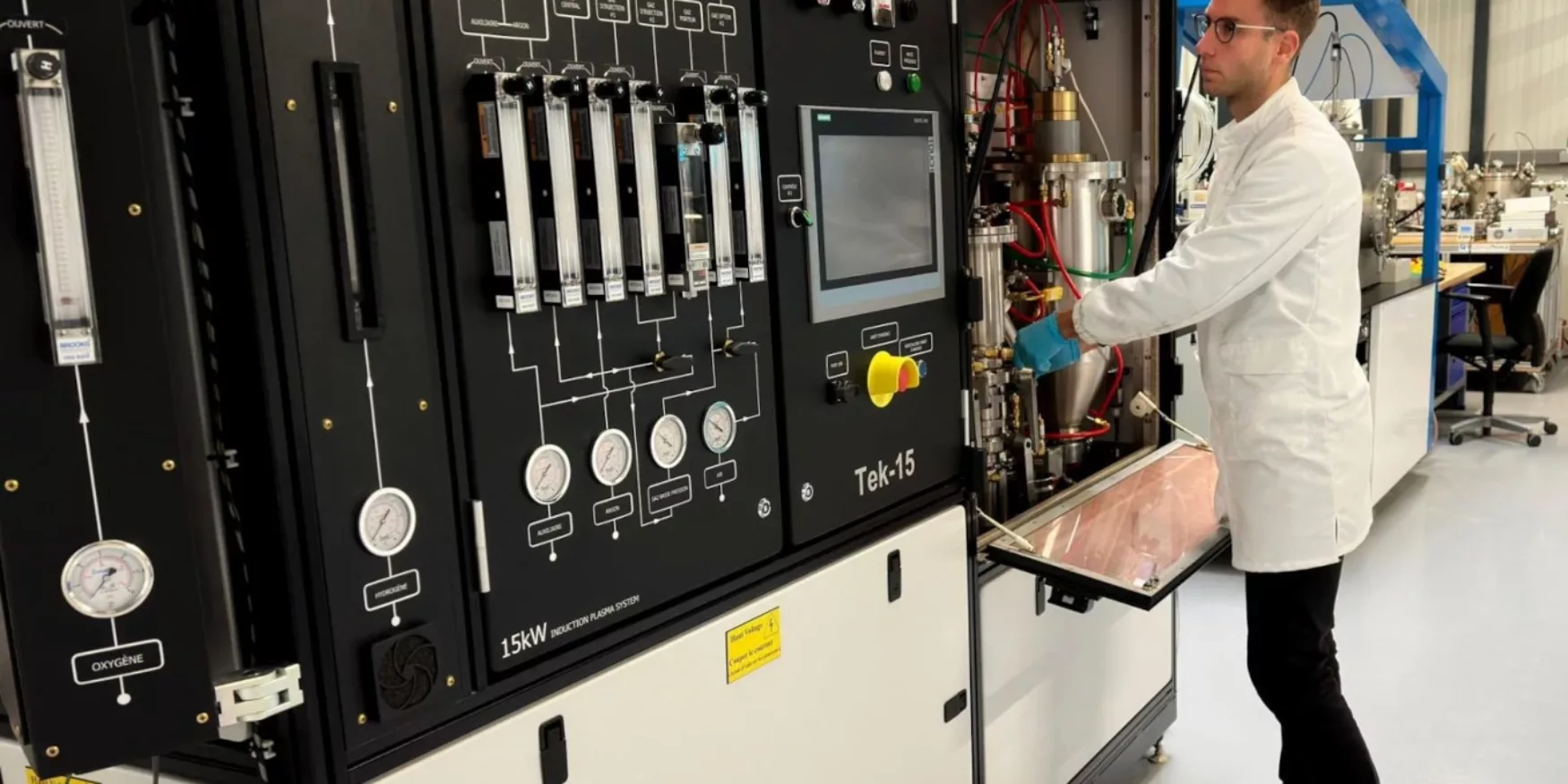
To improve the properties of these powders, a hydrogenated–dehydrogenated (HDH) titanium powder was spheroidized at Materia Nova. To do so, a spheroidization technology was used, relying on a radio‑frequency (RF) plasma torch acquired through the REMADE program (“REcycled MAterials for aDvanced manufacturing tEchnologies”, a priority project under Plan de Relance de la Wallonie).
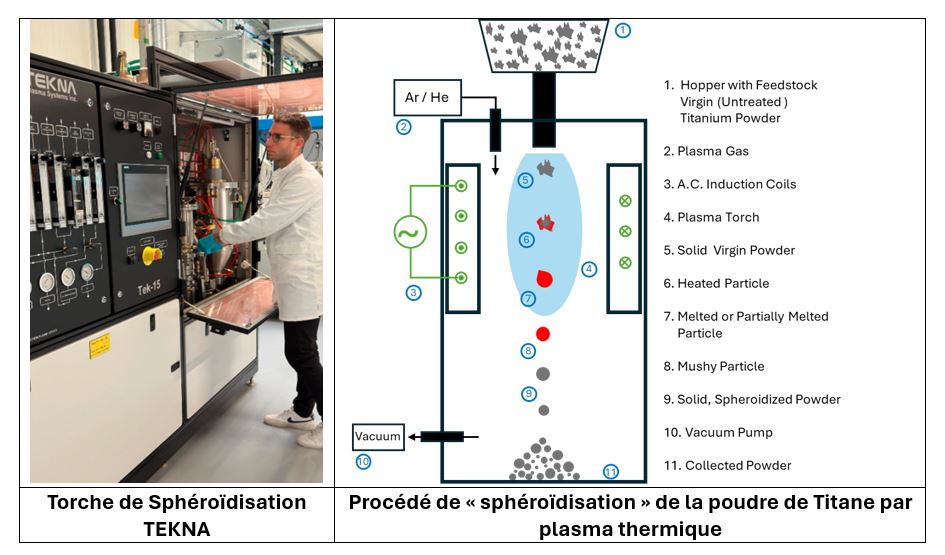
Scanning electron microscopy observations were carried out on titanium powders before and after plasma torch treatment. This treatment proved highly effective, leading to a radical change in particle shape, which transformed from irregular geometries to regular spheres.
Imageries MEB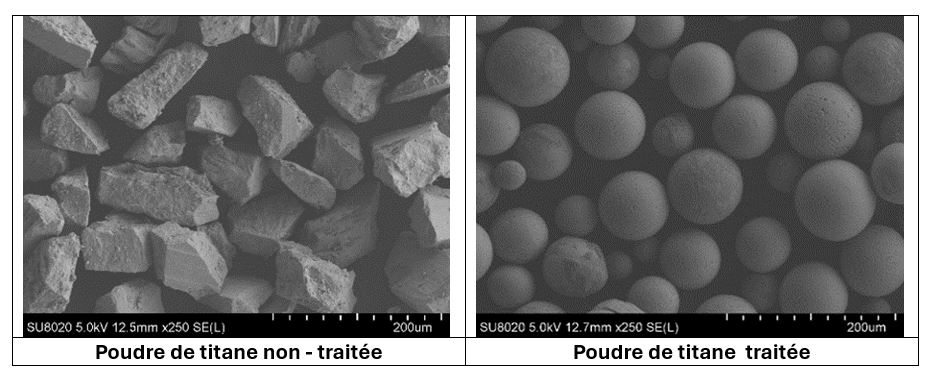
Our first RF plasma spheroidization tests on titanium powders were a success. This plasma technology stands out for its ability not only to improve the shape of powders but also to modify their chemistry (reduction, oxidation, nitridation, etc.).
These modifications provide essential benefits, such as spherical morphology, increased density and purity, improved homogeneity, and enhanced flow properties.
As a result, plasma‑treated powders have become a preferred choice for metal injection molding (MIM) and additive manufacturing (AM), two fields where material quality is paramount.