
27.03.2026
UMONS and Materia Nova are launching the first European hub dedicated to micro- and nanoplastics
UMONS
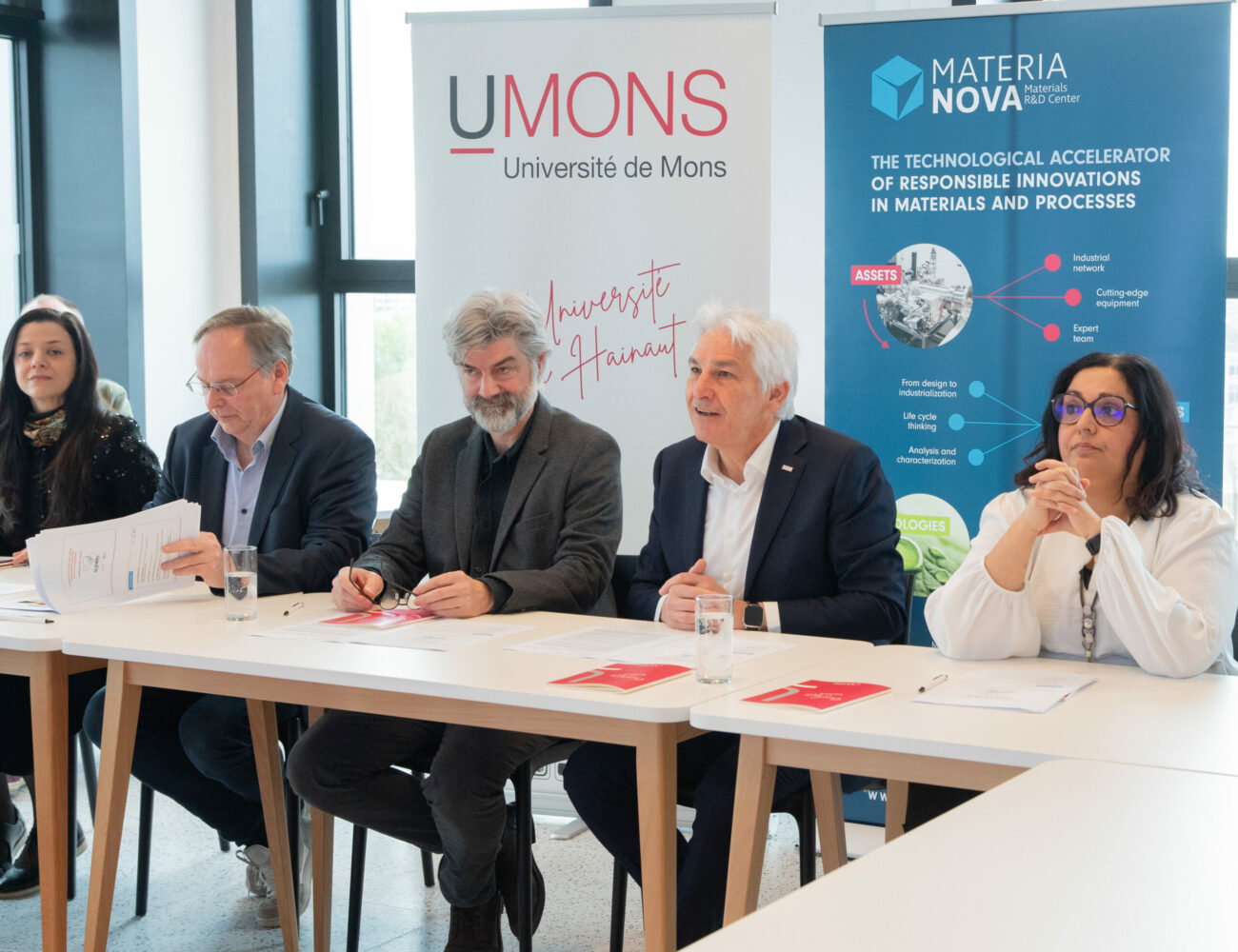
On Friday 27 March 2026, UMONS and Materia Nova officially launched the Hainaut Micro- and Nanoplastics Hub, a unique European initiative designed to better understand and combat this pervasive form of pollution, now recognised as a global health emergency.
This European first has just been established in Mons. Inaugurated on Friday 27 March 2026 at the UMONS Materials Science building, the Hainaut Micro- and Nanoplastics Hub aims to shed light on a form of pollution that is as invisible as it is worrying, and which is now present even within the human body.
Resulting from the degradation of plastics, micro- and nanoplastics now contaminate every part of the environment: soil, water and air. In a context where global plastic production already stands at nearly 460 million tonnes – and could exceed one billion by 2060 – their presence continues to grow.
Even more worrying is that these particles have crossed a new frontier: that of living organisms. Ingestion, inhalation or skin contact now allow them to enter the human body, where they have been detected in several organs and biological fluids. Recent studies have even highlighted their presence in the brain, at concentrations that are clearly on the rise.
Beyond their mere presence, micro- and nanoplastics are a source of serious scientific concern. Capable of crossing biological barriers, they can carry toxic substances such as heavy metals or organic pollutants. Their potential effects – inflammation, oxidative stress, neurological toxicity – raise questions about their role in the development of major diseases.
“Today, the real scientific challenge is no longer whether micro- and nanoplastics are present, but whether we can track, understand and control them at the level of living organisms,” explains Samira Benali, a researcher at UMONS within the Polymer and Composite Materials department. “The aim is to move from invisible pollution to pollution that is measurable, traceable and, ultimately, controllable,” she adds.
Structuring research and accelerating solutions
Faced with this issue, which is still largely underestimated, the new Hub aims to structure research and bring together expertise that has hitherto been scattered. Jointly led by UMONS and Materia Nova, it brings together expertise in materials science, the environment, biomedicine and engineering.
“This is precisely the Hub’s ambition: to bring together, for the first time, all the expertise needed to tackle this issue in a comprehensive manner,” emphasises Prof. Philippe Dubois, Rector of UMONS and President of Materia Nova. “We want to accelerate discoveries and boost Hainaut’s international profile in this emerging field.”
The ambition is clear: to move from pollution that is difficult to detect to pollution that is measurable, traceable and, ultimately, controllable. To achieve this, the Hub is structured around three main areas: developing innovative methods to identify and characterise these particles, understanding their interactions with living organisms, and proposing concrete solutions to limit their impact.
This integrated approach relies in particular on cutting-edge technologies. “Thanks to local probe microscopy techniques coupled with infrared or Raman spectroscopy, it will be possible to clearly identify the nature (and even the origin) of the micro- and nanoplastics analysed on the basis of their mechanical, viscoelastic or chemical properties at the nanometre scale. Using a tailored standardised methodology and an original correlative analysis, we will be able to characterise these micro- and nanoplastics as well as any changes they may undergo over time,” explains Prof. Philippe Leclère, Director of the Laboratory of Nanomaterials Physics and Energy at UMONS and Coordinator of the MateriaLINKS platform.
Strengthening Hainaut’s international standing
Beyond fundamental research, the Hub also aims to strengthen Hainaut’s international standing, support European projects and train a new generation of researchers. “This pooling of expertise and equipment represents a major step forward in addressing a scientific, industrial and societal challenge,” explains Luc Langer, Director of Materia Nova. “Our University intends to position itself as a leading international player in a rapidly emerging field, at the crossroads of health, the environment and industrial innovation,” adds Ruddy Wattiez, Vice-Rector for Research at UMONS.
With the launch of the Hainaut Micro- and Nanoplastics Hub, UMONS and Materia Nova are taking a decisive step in the fight against a threat that is still poorly understood. “Faced with this urgent situation, we have chosen to act together to protect future generations. The future starts now,” concludes Antoniya Toncheva, R&D Programme Leader at Materia Nova.